Birding in British Columbia
A hub for birding information for British Columbia, Canada. Featuring Rare Bird Alerts, directory to nature clubs and online birding groups, birding forums, and more.
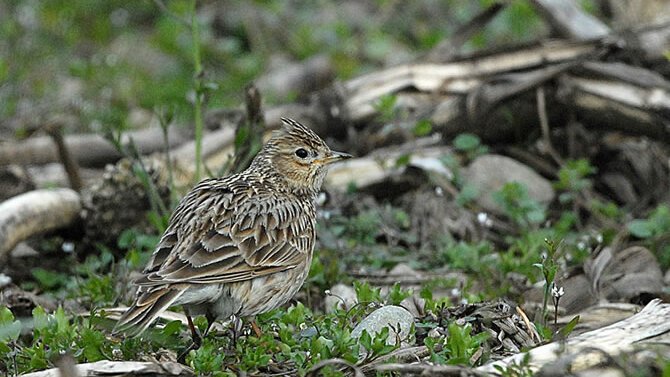
Eurasian Skylark on the Saanich Peninsula
Thinking about visiting Victoria, B.C. to see a Eurasian Skylark (Alauda arvensis)? You may want to do it sooner than later — under current trends, we will likely see the Skylark entirely extirpated from North America in the next few years. Sadly, the Washington State San Juan Island Skylark population has already been extirpated and was last reported from American Camp State Park in 2000.
At the height of their numbers (over 1,000 birds in 1965), the introduced Skylark ranged from South Victoria up to North Saanich with other small groups in the Cowichan Valley and on the Gulf & San Juan Islands. Today, their last remaining stronghold is restricted to the Victoria International Airport in North Saanich.
The population decline has been attributed to a number of factors including changing agricultural practices, urban sprawl and loss of farmland/field habitat, and predation from European Starling and Northwestern Crow. American Camp on San Juan Island suffered from additional predation from foxes and that is likely the cause of their extirpation there.
Unknown — possibly 1–6 (Spring 2026)
Breeding pairs: unknown
Location: Victoria International Airport
Finding a Skylark
Finding one is difficult even if you know where to look. Early morning is the best time to visit, when birds are most active. They occur in the short grass; your best chance is along Mills Rd. — pull over at the high points midway along and scope the fields.
eBird hotspots:
I.D. & Behavioural Tips
Skylarks behave similarly to American Pipits and can be found in similar open field and exposed dirt areas. Other species that occur in the same spaces include Savannah Sparrow, White-crowned Sparrow, Song Sparrow, Western Meadowlark, Killdeer, European Starling.
For those with good hearing, listen for the continuous song of warbles and twitters of a Skylark as it towers over the field "somewhere." (Cheer cheer cher rup tweedle cheer cheer rup reeup cheer wee cher… etc.) The song does carry and Skylarks can sound closer than they really are. When you hear a Skylark in flight, look from 10 to 60 degrees above the horizon. Skylarks are not easy to spot in the air as their lighter colouration helps them blend into a cloud or blue sky — the same challenge you face picking out an American Pipit or Savannah Sparrow in flight.
Skylarks are well camouflaged when on the ground. They may stay put and blend in, or move in short spurts and freeze again. Watching a Skylark on the ground requires focus or else you may lose it.
When flushed, a Skylark will give a "Cheerup" call (which sounds like an abbreviation of the towering flight call) and flap-and-glide low and away from your location.
Skylarks sing on territory from late January to mid July and tend to quiet down as the hot summer weather sets in. Shorter territorial songs may also be heard in fall and winter.
So, if you want to see and hear this wonderful bird, better plan your trip now.
Last Updated: May 2026
Birding in British Columbia is a BC Birding resource and community message board maintained by Kevin Slagboom | About